Festivals
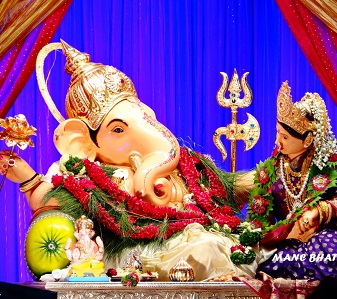
Ganesha Chaturthi or Ganesha Festival is a day on which Lord Ganesha, the son of Shiva and Parvati, resurrected to life on earth with the head of elephant. It is celebrated as it is the birthday of Lord Ganesha.. It is also known as Vinayaka Chaturthi or Vinayaka Chavithi in Sanskrit, Kannada, Tamil and Telugu, Chavath in Konkani and as Chathaa in Nepal Bhasa.
This festival is observed in the lunar month of bhadrapada (a Hindu month), shukla paksha chathurthi (fourth day of the waxing moon period), madhyahana vyapini purvaviddha. Typically, the day falls sometime between August and September . The festival lasts for 10 days, ending on Ananta Chaturdashi.
Ganesha, the elephant-headed son of Shiva and Parvati, is the supreme god of knowledge, wisdom, prosperity and good fortune. He is the Lord who is first worshipped before any holy occasion or puja.
Lord Vinayaka is revered as the preserver of all good things and prevents Vigna (meaning obstruction/bad omen). His motto is Shubh-Laabh (good prospect and good prosperity).
Significance of Ganesha Festival
According to the Holy Hindu scriptures, Lord Ganesha or Ganapati (the names mean “Lord of Ganas”, Ganas are the worshipers of Lord Shiva. According to the legend, Lord Shiva, the Hindu God of resolution, was away at a war. Pavarti, his wife wanted to bathe. She had no one to guard the door to her house, she conceived of the idea of creating a son who could guard her. Parvati created Ganesha out of the sandalwood paste that she used for her bath and breathed life into the figure. She then set him to stand guard at her door and instructed him not to let anyone enter. In the meantime, Lord Shiva returned from the battle.
Ganesha and Shiva did not know each other. Ganesha stopped Shiva from entering Parvati’s chamber. Shiva, enraged by Ganesh’s impudence, took his trident (Trishul) and cut off Ganesha’s head. Pavarti emerged to find Ganesha decapitated and flew into a rage. She took on the form of the Goddess Kali and threatened destruction to the three worlds of Heaven, Earth and the subterranean earth.
Fearing the inevitable, the other Gods implore Shiva to pacify Parvati. Shiva sent out his ganas, or hordes, to bring the head of the first living being with his head towards the north (the auspicious direction associated with wisdom). They came across was an elephant. So they brought the head of this elephant and Shiva placed it on the trunk of Parvati’s son and breathed life into him. Parvati was overjoyed and embraced her son, the elephant-headed boy whom Shiva named Ganesha, the lord of his ganas.
There are many stories related to Lord Ganesha, on Ganesha Chaturthi, one should not see the Moon. It is said that Ganesha fond of Modakas ate too many of them. His stomach was so big he was unable to walk. He picked up a snake on the way and tied it to his stomach as a belt. The Moon or Chandra found it hilarious and laughed at Ganesha. Ganesha was furious and his cursed him that any who sees the Moon on his birthday would be cursed.
Ganesha has a mouse as his Vahana (vehicle). Once Narada meets Lord Shiva and Goddess Parvathi in Kailash. He offers them a mango. Ganesha and Subramanya, who happened to be there fight for the mango. Hence a race is set to around all the world thrice, who ever comes first is the winner, would get the mango. Subramanya on his peacock, set out to win the race. But Ganesha, went circling round Shiva and Parvati three times, as he considered them as the world. Thus Shiva blessed him as the most knowledgeable and the winner of the race.
History of Ganesha Festival
In 1893, Lokmanya Tilak, an Indian nationalist, social reformer and freedom fighter Tilak chose Ganesha as a rallying point for Indian protest against British rule because of his wide appeal as “the god for Everyman”.
Ganesha Chaturthi as a National Festival “to bridge the gap between the Brahmins and the non-Brahmins and find an appropriate context in which to build a new grassroots unity between them” in his nationalistic strivings against the British.
Celebrations During Ganesh Chaturthi
Potters and their clan plan the making of Ganesh Idols, 2-3 months prior to Ganesh Chaturthi, life-like clay models of Lord Ganesha are made for sold by specially skilled artisans. They are beautifully decorated & depict Lord Ganesh in various poses, colours themes. The size of these statues may vary from 3/4th of an inch to over 25 feet.
While celebrated all over India, it is most elaborate in Maharashtra,Goa ( Biggest festival for Konkani people all over the world ) Gujarat, Karnataka and Andhra Pradesh, and other areas which were former states of the Maratha Empire. Outside India, it is celebrated by Newars in Nepal.
Ganesh Chaturthi starts with the installation of these Ganesh statues in colorfully decorated homes and specially erected temporary structures mantapas (pandals) in every locality. The mantapas are decorated specially for the festival, either by using decorative items like flower garlands, small banana saplings, lights, etc or are theme based decorations, which depict religious themes or current events.
The statues are worshiped with families and friends. The priest, usually clad in red silk dhoti and shawl, then invokes life into the statue amidst the chanting of mantras. This ritual is the Pranapratishhtha. After this the ritual called as Shhodashopachara (16 ways of paying tribute) follows.
The offerings include 21 durva (trefoil) blades of grass, red flowers, coconut, jaggery, 21 modakas. The statue is anointed with Kumkum & Sandalwood paste . Vedic hymns from the Rig Veda, the Ganapati Atharva Shirsha Upanishad, and the Ganesha stotra from the Narada Purana are chanted.